Calorie Tracking: yes or no? Burn Fat, Build Muscle, Stay Disciplined
Is calorie tracking worth it? Learn how monitoring calories can speed up fat loss, support muscle growth, and build discipline—without turning your life into stress.
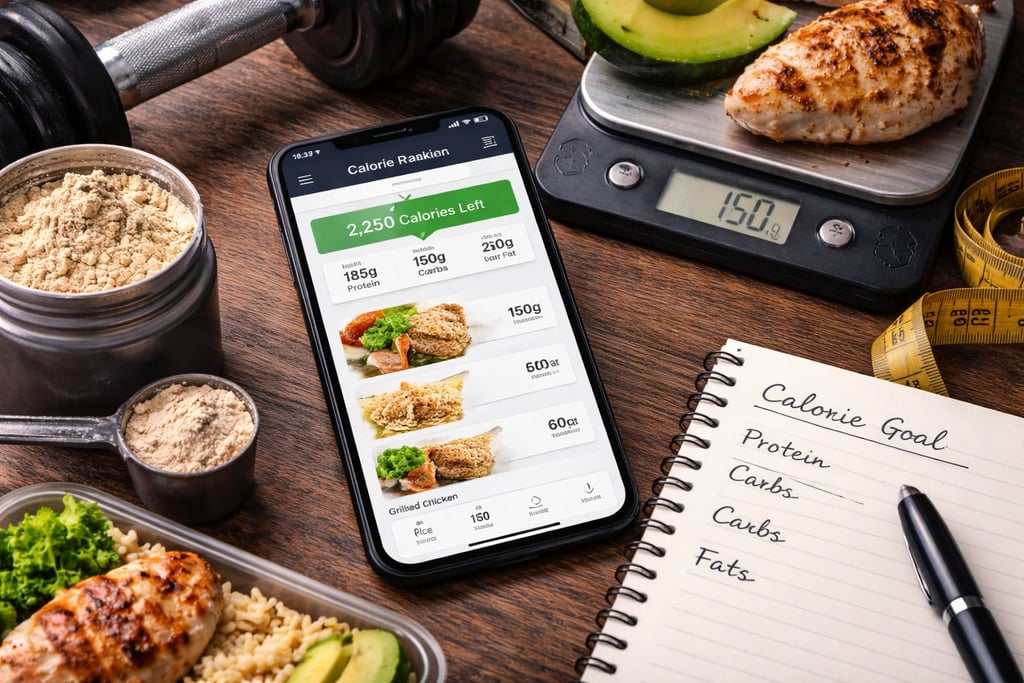
If you’ve read 37 Rules for Men, you know we touched on this topic through rules like:
Eat in Moderation
Reduce Sweets
Numbers Don’t Lie
Prepare Your Own Food
Maintain a Flat Stomach
Build Muscle
(If you haven’t read the book yet, you know where to find it: https://kdp.amazon.com/en_US/bookshelf )
Food is fuel — but it’s also pleasure.
What and how much you eat influences every area of your life:
your energy, your discipline, your confidence, your physique — even your finances.
So let’s address the real question:
Should you track calories?
Before I answer, let me tell you my story.
“Tracking Calories Is Stupid.”
For years, I thought calorie tracking was unnecessary.
A hobby for bored people.
How important can it really be how many calories you ate today? Or yesterday? Or every single day?
Just train hard. That’s enough. Right?
Wrong.
No matter how much effort I put into training, results were either slow… or nonexistent.
The stomach didn’t shrink.
Muscles didn’t grow.
That’s when I decided to test it for myself.
Long story short:
It makes a difference. A big one.
What Changed?
Almost immediately, I started seeing better results.
Body fat started dropping.
Muscles began replacing fat.
Progress became measurable.
But the biggest shift wasn’t physical.
It was awareness.
I became conscious of every bite.
Some foods I was eating in “healthy” quantities turned out to be calorie bombs.
Small snacks I barely noticed were quietly sabotaging my progress.
Tracking removed the illusion.
And illusions are the enemy of progress.
Is It Hard?
Honestly? Not as much as I expected.
In the beginning, it takes some time to build a database of foods you regularly eat.
After that, you simply enter quantities and occasionally add something new.
It becomes routine.
It becomes data.
It becomes power.
So… Is It Necessary?
Here’s the honest answer:
Yes, if you want faster, measurable results.
No, if a flat stomach and muscle growth are not priorities.
You don’t have to track calories.
But you also don’t have to reach your potential fast.
How to Start
1️⃣ Define Your Calorie Threshold
First, calculate your basal metabolic rate (BMR) — the number of calories your body burns at rest.
Then multiply it by your activity factor to get your daily maintenance level.
Eat around that number → maintenance (no fat gain or loss)
Eat below → calorie deficit (fat loss)
Eat above → calorie surplus (weight gain)
It takes one Google search or one AI prompt to get your number.
Simple.
2️⃣ Choose an App
The most famous app is MyFitnessPal, but I personally use Cronometer.
It’s:
Free
Simple
Functional
That’s all you need.
3️⃣ Focus on What Matters
Personally, I track:
Calories
Protein
That’s it.
You can go deeper, but don’t overcomplicate it.
If you eat something complex or don’t know exact ingredients — ask AI.
Use tools. Don’t guess.
4️⃣ Make It Social
Find someone to track with.
Sharing results, frustrations, and progress adds a competitive and motivating element.
It turns discipline into a game.
5️⃣ Be Honest
Log every bite.
Use a scale.
Don’t lie to yourself.
Your body already knows the truth.
Will You Have to Track Calories Forever?
Absolutely not.
After a few months, you’ll develop an intuitive sense of:
How many calories you’re eating
How much protein you’re consuming
The app becomes a temporary tool.
The awareness stays.
Turn It Into a Hobby
If you approach calorie tracking as punishment, you’ll quit.
But if you approach it as:
A data experiment
A body optimization project
A personal performance game
It becomes interesting.
And progress becomes addictive.
If you want a leaner body, more discipline, and faster results:
Track the numbers.
Because numbers don’t lie.
© 2026. All rights reserved.